


BV-XMRM · Engineering draft
XMRMesh
Offline Monero payments, from phone to phone.
What it is
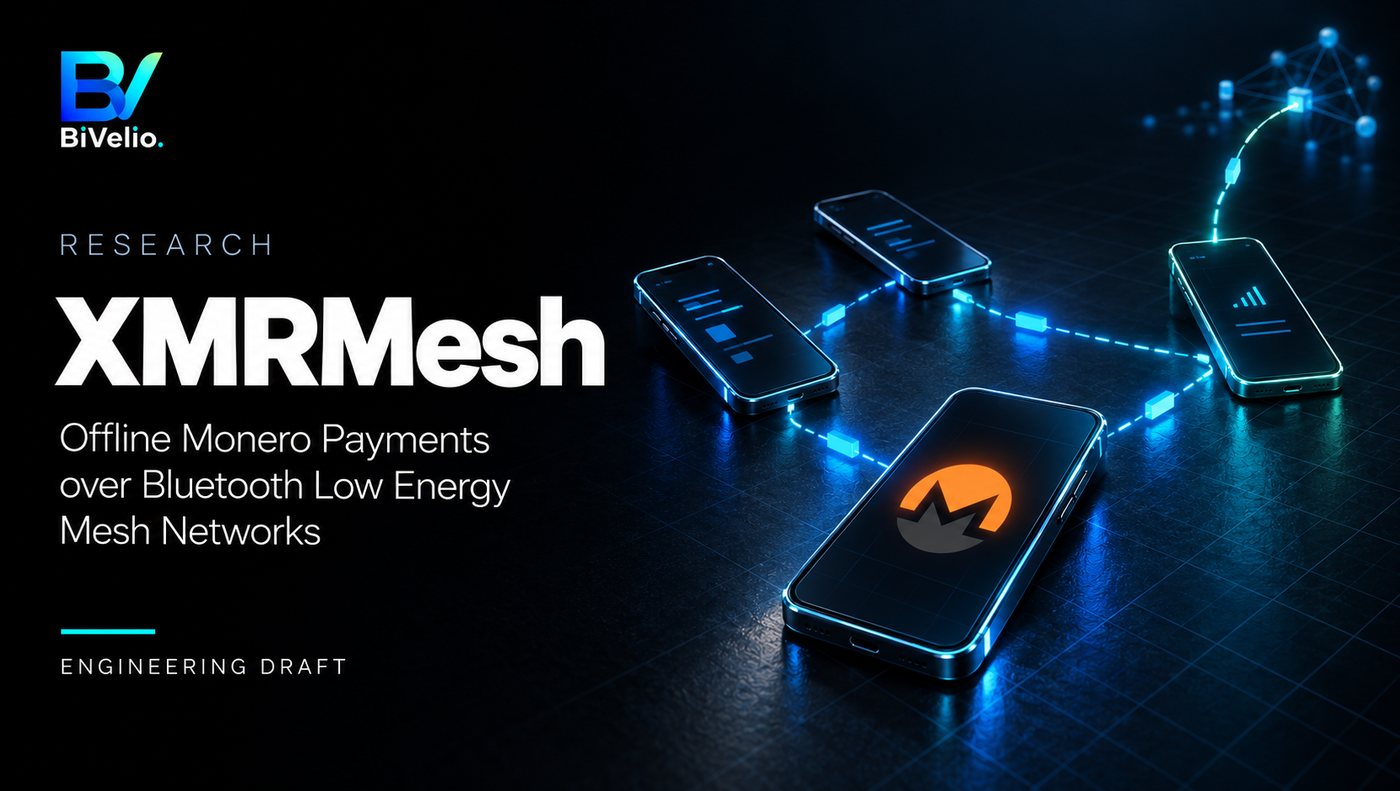
XMRMesh investigates whether a Monero payment can leave an area without internet. The transaction is prepared and signed on the phone itself, hops from phone to phone over a Bluetooth Low Energy mesh and is submitted to the network by the first peer with connectivity. It is a BiVelio Inc engineering draft: a proposed design with partial evidence, not a product.
How it works
- 1
While online, the wallet synchronizes: it stores its outputs, key images, fee data and a complete cache of decoys for the ring.
- 2
Offline, it builds the RingCT transaction from that cache and signs it (CLSAG) on the device itself.
- 3
The signed transaction is split into fragments of up to 470 data bytes and relayed over the mesh on a best-effort basis, with no guaranteed delivery.
- 4
Any connected peer acts as a gateway and hands the same bytes to a Monero node, optionally through Tor to hide its IP from that node.
- 5
Only on-chain confirmation settles the payment: a notice received over the mesh is a hint, never proof.
What has been demonstrated
- Native Android and iOS wallet engines build transactions offline from the cache, on a private regtest.
- One complete payment on the public stagenet, whose funds have no value: a 1,524-byte transaction built offline, submitted through Tor and independently verified at block 2,236,657.
- Synthetic fragmentation and reassembly vectors using the canonical RingCT identifier.
Limits
- Bluetooth relay between physical phones has not been tested yet: it is the next milestone.
- There is no privacy guarantee: radio, timing and size metadata remain.
- Double-spend hints circulating over the mesh are not proof; accepting a payment without on-chain confirmation is still a risk.
- The paper's capacity and latency figures are conditional illustrations, not measurements. No independent review.
The paper
Preprint BV-XMRM, version 1.7 (October 29, 2026): 28 pages, published by BiVelio Inc on Zenodo in the public domain (CC0 1.0). The official link is its DOI, 10.5281/zenodo.23762733, where it can be viewed and downloaded.
Status
Engineering draft: a proposed design with limited implementation evidence, in the BiVelio Research privacy and cryptographic systems series (No. 1). It is not in production.